If you've been watching Los Cabos and the surrounding Baja California Sur market from a distance, here's the short version: it didn't crash, and it didn't keep sprinting either. It grew up.
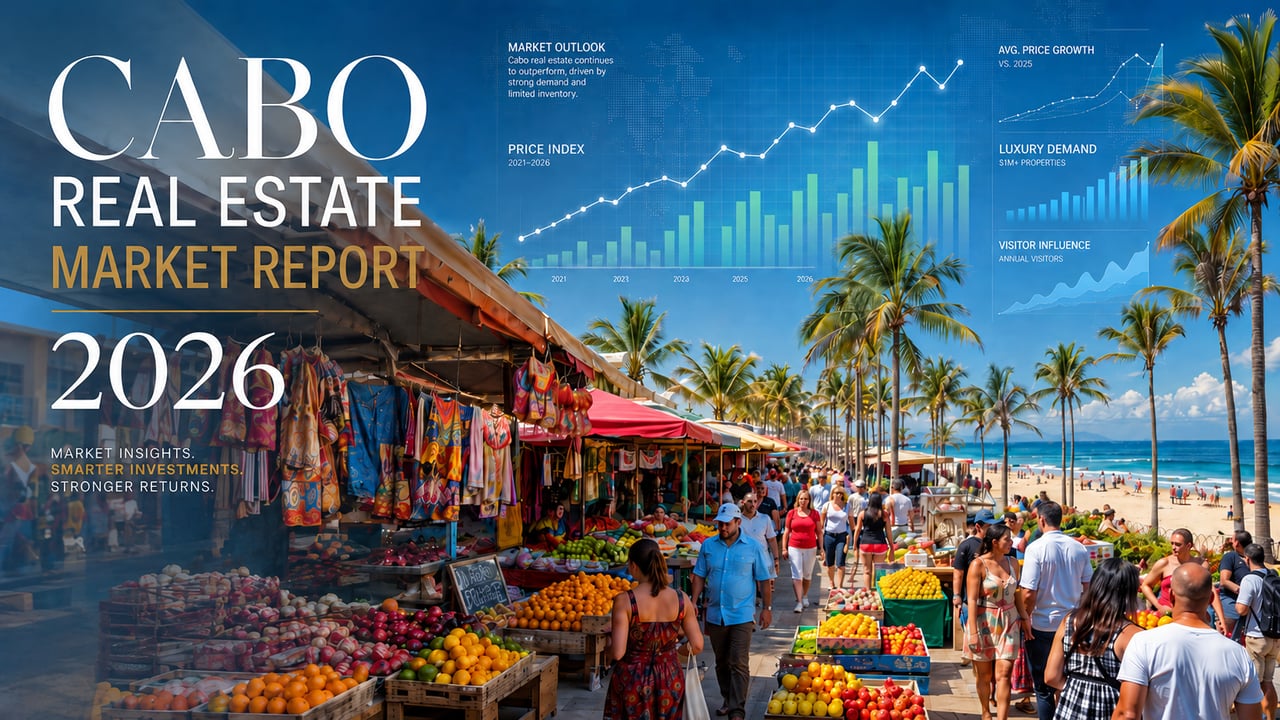
Total real estate sales volume across Baja California Sur reached $1.59 billion in 2025, a 12% increase over 2024. That's not a rebound from a downturn, it's a return to a more sustainable pace after the pandemic-era surge that saw volume swing from $1.60B in 2021 to $1.68B in 2023 before cooling. The market's current trajectory looks less like a boom-and-bust cycle and more like a place settling into its actual size.
Where the activity is happening
San José del Cabo led the region in 2025 with $711.8 million in total sales, split between homes ($418.9M), condos ($186.9M), and land ($105.9M). Cabo San Lucas followed at $374.5 million, with the Pacific Coast corridor at $277.8 million, La Paz at $94.8 million, and East Cape at $65.9 million.
Across all of Baja California Sur, 1,834 properties changed hands in 2025 at an average sale price of $854,409. Homes led the way, with 639 transactions totaling $918 million, a signal that buyers are increasingly choosing finished, move-in-ready properties over raw land.
Early 2026 data tells a similar story. The average sale price across all property types sat at $809,000 in Q1, with single-family homes averaging $1.17 million. Condos in Cabo San Lucas carry a median price around $900,000, actually higher than single-family homes in the same area, a reflection of how much of the condo inventory here skews toward luxury, ocean-view, resort-managed units.
What this means if you're buying
None of this points to a market in trouble. Baja California Sur is largely a cash-driven market, which means sellers aren't under pressure to discount just because transaction velocity has slowed in some segments. What has changed is the pace: well-priced, well-located properties still move, but buyers have more room to compare, negotiate, and take their time than they did during the 2021–2022 frenzy.
If you're earlier in your search, six months, a year, two years out, this is a good window to actually learn the market instead of reacting to it. If you're closer to ready, the properties worth chasing are the ones priced to current data, not last cycle's comps.
A quick word on ownership: the Fideicomiso
One question comes up in nearly every conversation with US and Canadian buyers: can I actually own property on the coast? Yes, through a fideicomiso, a bank trust that's been the standard mechanism for foreign coastal ownership in Mexico since the 1970s. A Mexican bank holds the title, but you retain full rights to use, rent, sell, renovate, or pass the property to your heirs. It typically costs around $1,500 to set up and $500–700 a year to maintain, with a renewable 50-year term. It's not a lease and it's not a workaround, it's simply how the law requires foreign ownership to be structured in the coastal zone, and it's been tested for decades.
Closing costs in Mexico generally run 4–6% of the purchase price, covering the notary, acquisition tax, and trust setup, worth budgeting for early rather than discovering at the closing table.
Where to go from here
Markets like this reward people who ask good questions before they ask about price per square foot: how's the HOA managed, what's the rental history, what infrastructure is planned nearby. If you want a straight read on what a specific neighborhood or price point looks like right now, that's exactly the kind of conversation I like having, no pressure, just the actual numbers.
Reach out anytime at www.bajabysteve.com, or send a message directly if you want a market breakdown for a specific area you're watching.
— Steve Holland, BAJAbySteve | Coastaro Real Estate